APEC must seek trade liberalisation in atmosphere of protectionism: professor
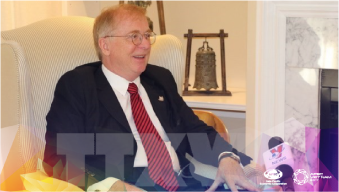
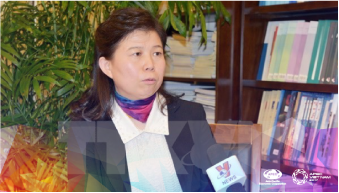
Dr Carl Thayer, Emeritus Professor at the University of New South Wales, Australia, and an expert on Southeast Asia, talks to Vietnam News Agency about the APEC Economic Leaders’ Meeting that took place in Đà Nẵng City in early November:
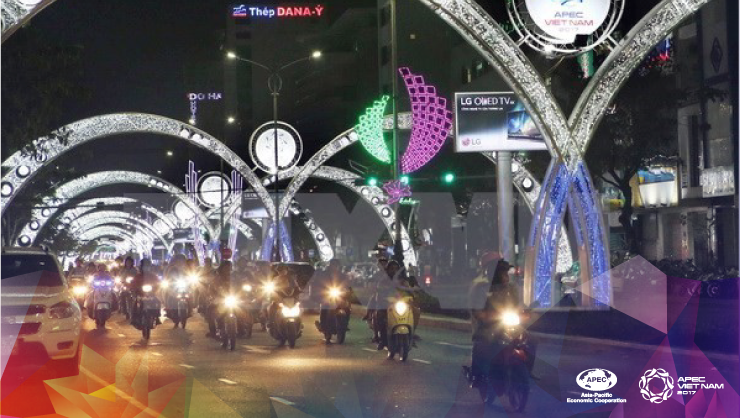
Welcome gate with symbol of 2017 APEC Economic Leaders' Week on Da Nang street. (Source: Trần Lê Lâm/TTXVN)
The major concern for most APEC member economies was how to advance their goal of achieving further liberalisation of trade and investment in the Asia-Pacific Region through the Free Trade Agreement in Asia and the Pacific (FTAAP) at a time of rising anti-globalisation and protectionism.
Allied to this, APEC members would be concerned to maintain the relevance of their organisation at a time of challenges raised by competing initiatives such as the Regional Comprehensive Economic Partnership (RCEP) and China’s Belt and Road Initiative as well as President Donald Trump’s shift away from multilateralism to bilateralism in trade.
APEC members need to commit to implementing the Lima Declaration on the FTAAP by developing multi-year work plans and setting out key milestones.
The major challenges to trade facilitation and economic development are protectionist sentiment in countries experiencing low rates of growth and resistance to new and higher standards such as embodied in the now defunct Trans Pacific Partnership. These higher standards include emphasis on liberalising services, protection for intellectual property rights, opening up for e-commerce and digital trade and women’s empowerment.
APEC members need to completely support the World Trade Organisation Agreement on Trade Facilitation to lower costs by improving how the global supply chain functions and eliminate non-trade barriers.
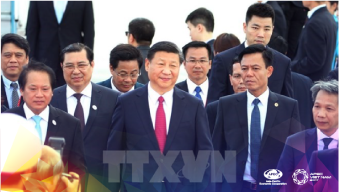
To balance relationships among powers who are also APEC members, Việt Nam has used the opportunity as chair for APEC 2017 to host official visits to Hà Nội by China’s President Xi Jinping and US President Donald Trump. This is not a particularly tough time for Việt Nam because there is growing convergence between Beijing and Washington on how to deal with the nuclear threat in North Korea and how to settle differences over bilateral trade. Xi Jinping has taken a global leadership role in supporting globalisation while Donald Trump has favoured protectionism through his America First policy.
Vietnamese diplomacy has always been adept at playing off differences and convergences in the material interests of major powers. As a result both China and the United States will see it is in their interest to support Việt Nam’s autonomy and role as a positive contributor to regional security.
Việt Nam has already put in the necessary effort to push APEC’s reform agenda in the many meetings by working groups, senior officials and ministers already held. Việt Nam will have to exercise proactive leadership to overcome any unexpected logjams on particular issues.
The APEC Economic Ministers have set the necessary priorities. Việt Nam needs to lobby for financial and other support to advance its own national development. The best way to achieve this is to hold bilateral meetings and host separate official visits by key government leaders.
Việt Nam’s hosting of the APEC Summit for the second time illustrates the importance of its long-standing policy of diversifying and multilateralising its external relations. During this summit, Việt Nam was able to showcase its economic development in the modern city of Đà Nẵng and demonstrate that Việt Nam is a strong and positive contributor to regional and global security. In turn, Việt Nam can solicit further support from APEC’s developed economies to advance its development goals. — VNS