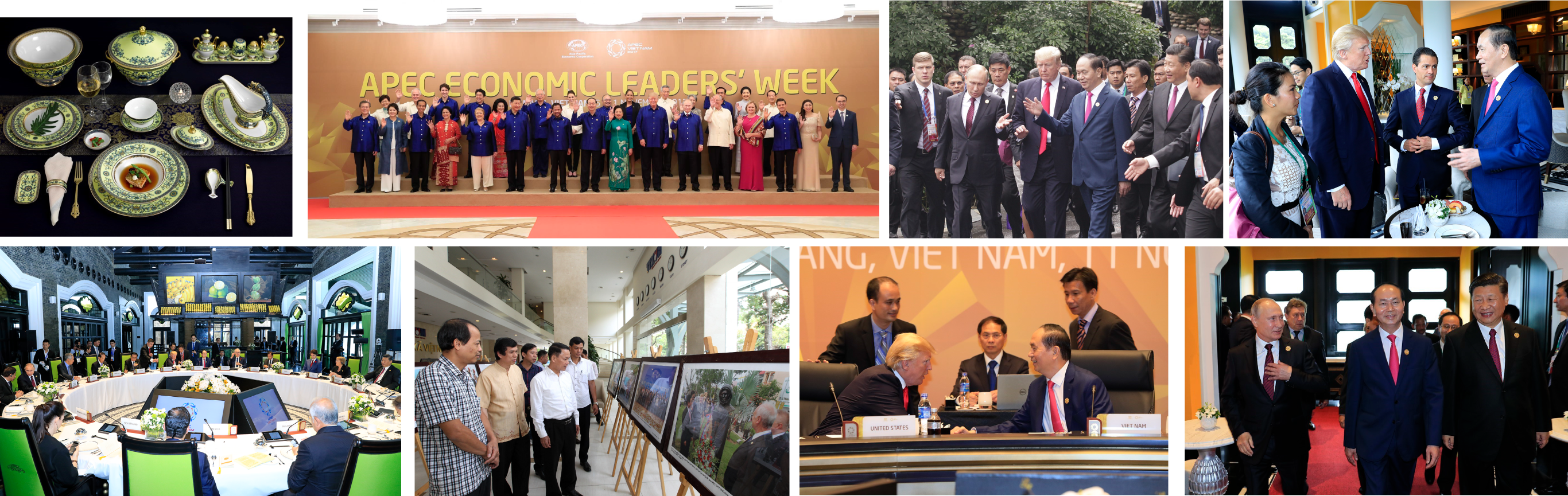
The APEC Vietnam 2017 themed “Creating New Dynamism, Fostering a Shared Future,” with the culmination being the 2017 APEC Economic Leaders’ Week in Đà Nẵng City from November 6-11 has been a success, highlighting the role of Việt Nam in the process of APEC's continuous development, promoting the trend of peace, stability, cooperation and development of the region and the world, meeting the wishes and interests of all member economies.
The results of APEC 2017 have created an important foundation for APEC cooperation in the new phase. The high-level week has approved eight important documents, especially the Đà Nẵng Declaration and the Joint Ministerial Statement. For the first time, APEC agreed to promote inclusive economic, financial and social development, and innovative start-ups.
This is one of the few summits in the last 10 years which saw the full participation of all 21 APEC leaders. This demonstrates the commitment and political will of the members to the forum and to the Asia-Pacific region.
The results of APEC 2017 have created an important foundation for APEC cooperation in the new phase. The high-level week has approved eight important documents, especially the Đà Nẵng Declaration and the Joint Ministerial Statement. For the first time, APEC agreed to promote inclusive economic, financial and social development, and innovative start-ups.
APEC leaders also set out major orientations for promoting APEC cooperation by 2020 and preparing for a vision after 2020 towards an APEC for the people and businesses; contributing to the building of a peaceful, stable, dynamic, connected and prosperous Asia-Pacific community; promoting APEC leadership role in responding to new global challenges. Accordingly, the members agreed to establish the APEC Vision Group.
At the APEC Economic Leaders' Meeting - the most important event of the APEC Vietnam 2017, leaders adopted the Đà Nẵng Declaration in which they pledge to work together and take the following actions:
First, through the APEC Action Agenda on Advancing Economic, Financial and Social Inclusion, leaders of member economies confirm the determination towards promoting innovative growth, inclusion and sustainable employment of the APEC community. This is also an important issue in the dialogue between APEC economic leaders and the business community.
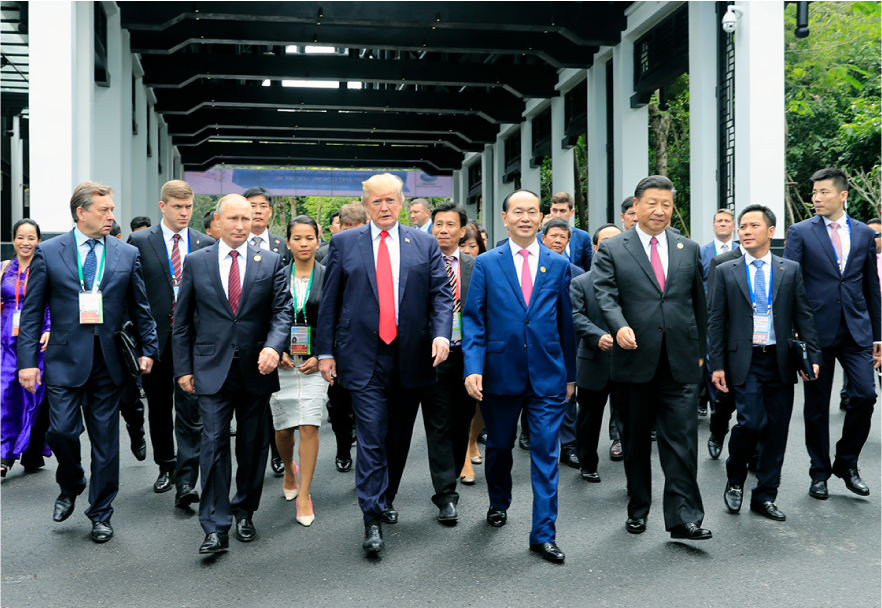
President of the Socialist Republic of Viet Nam H.E. Tran Dai Quang with leaders of APEC member economies. (Source: TTXVN)
Second, in order to improve the quality of growth, competitiveness and productivity of APEC economies, the urgent need is to increase the quality of education, equip workers with knowledge and necessary skills to better adapt to the working environment and labour market which are fundamentally altered by the Fourth Industrial Revolution. Aware of that, the leaders adopted the Framework on Human Resources Development Framework in the Digital Age. Policy orientations and measures set out in the framework are expected not only to meet the common interest of the region, but also to leverage Việt Nam to continue implementing effectively breakthrough development strategies on human resources, especially high quality human resources.
Third, in order to create new dynamism for sustainable and inclusive growth, the leaders spent considerable amount of time discussing policies and strategic measures to develop micro, small and medium-sized, green, sustainable and creative enterprises; promote creative start-ups; develop a sustainable agriculture sector adapt to climate change; enhance food - water – energy security; develop rural and urban areas; speed up structural reform; enhance capacity; mitigate disaster risk; increase economic empowerment for women; and develop sustainable tourism.
The implementation of APEC's long-term cooperation frameworks in these areas is expected to contribute to strengthening the role of the forum as the region's leading regional economic cooperation mechanism and leading the global efforts for sustainable development, as the common goals to be achieved by 2030 that the United Nations has set.
The implementation of APEC long-term cooperation frameworks in areas such as micro, small and medium enterprise development; creative start-up promotion; sustainable agriculture development ... is expected to contribute to strengthening the role of the forum as the region's leading economic cooperation mechanism and leading the global efforts for sustainable development.
Fourth, advancing free and open trade and investment in the Asia-Pacific region is the mission of APEC economies. In order for APEC to continue to be a driving force in linking and connecting the region, and to be a driver of global economic growth and linkages, the leaders reaffirmed their commitment to attain the Bogor Goals on trade and investment liberalisation; promote the facilitation of investment, business and services; strengthen economic and technical cooperation; and continue making efforts towards the formation of the Asia-Pacific Free Trade Area (FTAAP).
The leaders underlined the role of APEC in supporting a rules-based, free, open, fair, transparent, and inclusive multilateral trading system. The leaders also welcomed the adoption of the APEC Internet and Digital Economy Roadmap and the APEC Framework on Cross-border E- commerce Facilitation, to facilitate APEC's effective exploitation of the potentials of. Internet-based economy, digital economy, supply chains and global value chain.
Fifth, APEC is working harder than ever to complete the Bogor Goals by 2020 and prepare itself for the fourth decade of development. To enhance APEC's role and position in the multilayered international arena, APEC economic leaders welcomed the establishment of the APEC Vision Group to assist senior officials in identifying directions and the future of the forum after 2020.
It is a self-reliant forum capable of handling global challenges as well as highly adaptable to a rapidly changing world. This decision also represents the determination of member economies toward building a peaceful, stable, dynamic, connected and prosperous Asia- Pacific community in which people and businesses are centrally located.
Within the framework of the 2017 APEC Economic Leaders’ Week, some other outstanding results were also achieved.
One of the highlights of this high-level week is the success of the TPP-11 negotiations.
On the sidelines of the APEC Economic Leaders' Meeting on November 11, trade ministers of 11 economies in the Asia-Pacific region met informally and reached important agreements on the major issues of the Trans-Pacific Partnership (TPP). Ministers agreed to reach a Comprehensive and Progressive Trans-Pacific Partnership (CPTPP) to replace the TPP.
Ministers from the 11 participating countries (except the United States) issued a joint declaration stating that the members agreed on the core issues of this agreement. Accordingly, contents of TPP agreement remain unchanged to ensure the high quality of the agreement, and member economies are allowed to postpone certain obligations to ensure a balance in the new context. Based on this declaration, ministers assigned heads of the negotiating delegation to continue to deal with technical issues on which consensus has not yet reached as well as to conduct legal review to prepare for the signing of the agreement.
The CPTPP agreement basically retains the core content of the TPP, but there are also some differences. First, CPTPP has 11 member economies, one less than TPP.
Second, in terms of scale, the CPTPP covers only 14 per cent of global GDP, about 15 per cent of global trade and 500 million people. Meanwhile, the TPP covers 40 per cent of GDP, about 30 per cent of global trade and has 800 million people.
Third, in terms of content, CPTPP consists of 30 chapters, covering many issues such as trade, investment, taxation, intellectual property, working environmental, basically maintaining the content of the TPP. The CPTPP, however, has two new appendices, one covering 20 TPP obligations postponed and four for renegotiation, and another appendix covering seven technical issues of the new agreement.
Many analysts expect the CPTPP to be implemented soon before it can open up to other potential economies, including South Korea.
TPP was signed in February 2016, with 12 participating countries including Australia, Brunei, Canada, Chile, Japan, Malaysia, Mexico, New Zealand, Peru, Singapore, the US and Việt Nam. However, right after taking office in January 2017, President Trump announced the country’s withdrawal from the TPP, arguing that the multilateral treaty would affect American jobs and stressed that Washington would proceed negotiations of bilateral trade agreements. Nevertheless, the remaining 11 members attempted to revive the agreement through negotiation rounds.
The joint declaration marks the success of the negotiation process in Việt Nam. The results achieved in Đà Nẵng show the great efforts of the 11 TPP members to promote economic development, create jobs, improve the lives of people, facilitate trade development and strengthen cooperation among economies in the region, as well as prove efforts made by member countries to open up and integrate effectively into the world. Many analysts expect CPTPP to be implemented soon before it can open up to other potential economies, including South Korea.
Dialogue between the APEC economic leaders with the APEC Business Advisory Council (ABAC)
Attending the dialogue were APEC economic leaders and 63 ABAC representatives who were businessmen in the APEC region. In the meeting, APEC economists and ABAC representatives have shed more light on policies and solutions aimed at strengthening cooperation between governments and the business community in ensuring inclusive economic development; strengthening the participation of micro, small and medium-sized enterprises in the global market; and actively contributing to making APEC a more effective cooperation mechanism to promote sustainable growth and create jobs for people.
The 29th APEC Ministerial Meeting
The meeting welcomed the endorsement of the “APEC Towards 2020 and Beyond” paper, which is an important deliverable of APEC 2017. This is the initiatives of Việt Nam and a mark of APEC 2017 cooperation in preparation for APEC to enter its fourth decade of development and to accelerate the completion of the Bogor Goals on trade and investment liberalisation by 2020.
The ministers also adopted many important and practical initiatives, notably four documents: the APEC Cross-Border E-Commerce Facilitation Framework; the APEC Strategy on Green, Sustainable and Innovative SMEs; the Food Security and Climate Change Multi-Year Action Plan 2018-2020; and the Action Plan on Rural-Urban Development to Strengthen Food Security and Quality Growth.
The first informal dialogue between APEC and ASEAN
In order to promote APEC's role as a mechanism for initiating and coordinating regional integration and networking ideas, Việt Nam organised the first the APEC and ASEAN Informal Dialogue under the theme “Partnering for New Dynamism for a Comprehensively Connected and Integrated Asia-Pacific”, with the participation of APEC leaders and 10 ASEAN leaders.
From November 6 to November 11 2017, APEC Economic Leaders' Week was held in Da Nang under the theme "Creating new dynamism, fostering a shared future." The event was comprehensively successful and would bring in a good chance to promote Vietnam's image to the world. Source: TTXVN
Inspired by a shared vision for a comprehensively connected and integrated Asia-Pacific, the APEC and ASEAN Leaders exchanged views on the urgent need and measures to strengthening cooperation and synergies between the two mechanisms in addressing common challenges and reinforcing a sustainable, transparent and highly-adaptable regional economic architecture.
They highlighted various areas of potential cooperation, including trade and investment; promotion of physical, institutional and people-to- people connectivity; supply chains connectivity, global value chains; globalisation of micro, small and medium enterprises, human resources development, and addressing climate change, among others.
The two sides also provided updates on the implementation of the relevant regional economic integration initiatives, including the Free Trade Area of the Asia-Pacific (FTAAP), the Regional Comprehensive Economic Partnership (RCEP) and the Trans- Pacific Partnership Agreement.
With the successes of APEC and ASEAN over the past decades in promoting regional integration, both forums are expected to continue contributing to promoting the role of Asia-Pacific region as a driving force for growth and global economic connection.
Leaders of APEC and ASEAN welcomed Việt Nam’s initiative to host the Dialogue and considered it as a vivid testament of the will and determination of their respective members in reinforcing a comprehensively integrated and inter-connected Asia-Pacific for peace, stability, dynamism and prosperity.
It can be said that, through the activities of the APEC Vietnam 2017, Việt Nam's role as an active and responsible member of the international community, and its contribution to fostering peace, cooperation and prosperity of the region have been recognised.
In his speech at the APEC summit, President Trần Đại Quang stressed that Việt Nam is an active and responsible member of the international community and an open and deeply and widely integrating economy with stable growth rates in many past years.
The APEC Vietnam 2017 is a precious opportunity for Việt Nam to contribute to promoting peace, cooperation and prosperity in the region. This is also an opportunity for Việt Nam to affirm its foreign policy of independence, self-reliance, diversification, multilateralism and international integration.
Over the past year, APEC senior officials, ministers, business community and academics in the region have conducted more than 240 meetings in 10 provinces and cities of Việt Nam. Delegates seriously and thoroughly discussed, and consistently proposed measures to promote dialogues, cooperation and linkages in APEC, creating new impetus for regional economic growth and linkages, and prepare well activities of the 2017 APEC Economic Leaders’ Week.
Through APEC, regional economies have come to know the dynamics and renewals of the Vietnamese economy, opening the door for new flows of investment, trade and tourism in Việt Nam. Việt Nam's cultural programmes to promote the country’s image to APEC and the world, such as the APEC Park in Đà Nẵng, show its rich tradition, innovation and creativeness.