Tourism has always been considered as one of the spearheads contributing to growth and employment opportunities for the global economy in general and Asia-Pacific Economic Cooperation (APEC) member economies in particular.
However, the ongoing climate change has presented a major global challenge and affected quite a few aspects of the economy, society and culture. Even the tourism industry has not been spared these effects and in fact, is one of the most affected sectors.
How to exploit the tourism potential to promote the added values of each member economy while ensuring sustainable development in the context of climate change has been a great concern for the APEC in recent years. This is also an important theme for 2017 APEC hosted by Viet Nam. Many conferences, round table meetings and high-level dialogues were held with the participation of the tourism policymakers in the region. Viet Nam, as the host country for the 2017 APEC, has launched several initiatives on this issue, which have been highly appreciated by the member countries.

According to Minister of Culture, Sports and Tourism Nguyen Ngoc Thien, tourism has always been a priority of the APEC cooperation right after the forum was established in 1989.
APEC tourism cooperation officially began in 1991 with the formation of the APEC Tourism Working Group (TWG). The TWG has been tasked to develop a common strategy for tourism by attaching four tourism policy objectives of the APEC with the tourism strategy of each economy and the development of the tourism industry in the whole region. They formed the APEC Tourism Charter, which included removing barriers to trade and investment in the tourism sector; increasing the travel of tourists, meeting the demand for goods and tourism services; sustainable management of tourism impacts and effects; and raising awareness and understanding of tourism as a means of socio-economic development.
The TWG has studied tourism obstacles to remove trade and investment barriers in the service sector, develop best practices and the idea of safety and security for APEC economies to fight against terrorism in the tourism sector, and establish the APEC International Center for Sustainable Tourism.
In 2000, the first APEC Tourism Ministerial Meeting held in South Korea adopted the APEC Tourism Charter, an important and directional document which laid the foundation for APEC tourism cooperation.
The APEC Tourism Ministerial Meeting organised once every two years adopts a declaration demonstrating the determination of the APEC tourism leaders to promote tourism into an important economic sector, making it a tool to promote cultural exchanges, boost cooperation and bring about significant effects to the goal of poverty reduction and comprehensive growth, thus helping increase incomes for the local communities and improve social welfare.
The APEC has implemented a series of activities related to sustainable development, focussing on developing responsible tourism and building a sustainable environment for tourism competitiveness, which is one of the key directions of the APEC Tourism Development Strategy.
The APEC is becoming an increasingly attractive and friendly destination to visitors both inside and outside the region. The number of visitors entering the region is on the increase. Tourism contributes significantly to the values of the economy and provides regional employment.
The APEC tourism is confidently targeting some 800 million international visitors by 2025.
According to the World Tourism Organization, tourism is both a cause and a victim of climate change. Being an economic sector sensitive to natural environment conditions, tourism is seriously influenced by climate change impacts. According to analysis, climate change will directly affect three main groups — tourism resources, infrastructure and technical facilities for tourism, and travel.
Tourism resources are considered a basic foundation for tourism development. Any change in the quality and the number of tourism resource types will have a significant impact on the development of this sector.
As part of the tourism resources, climate resources will be directly affected by climate change, because climate change will result in changes in temperature, humidity and conditions to develop resort tourism — one of the main tourism types which is more and more popular today.
Climate change will also alter the living conditions and directly affect growth, development and even survival of many ecosystems, as well as valuable, rare and endemic species.
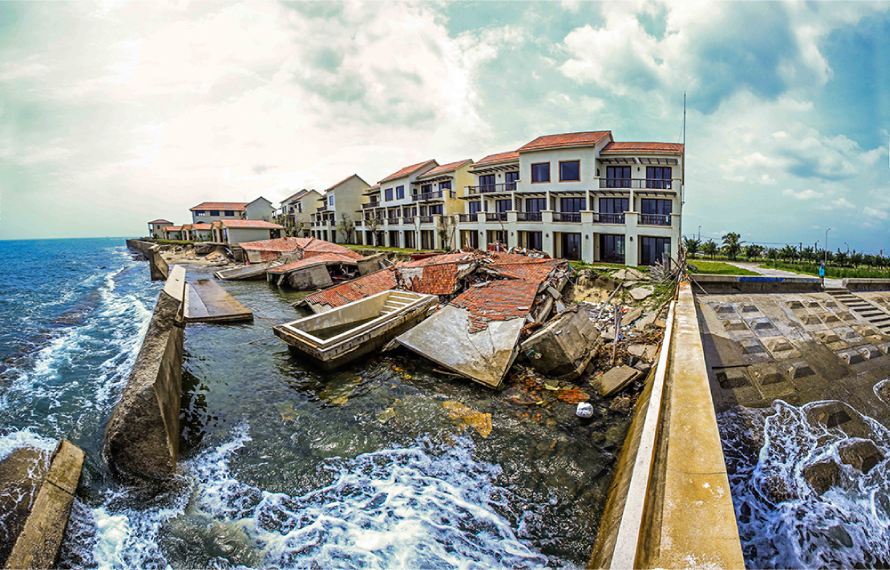
The resort of Alya, Hội An seens under violent erosion and serious landslides leading to a halt in construction on the abandoned Âu Cơ road along the coast of Cửa Đại. (Photo: Trọng Đạt / VNA)
Another great impact of climate change is the occurrence of extreme weather events with large magnitude and intensity. The impacts of typhoons, floods and long-term flooding will cause damages and even losses of many cultural and historical relics considered a special type of tourism resource that plays an important role in tourism development.
In the process of development, APEC tourism has experienced many difficulties and challenges, especially those brought about by the nature. However, as an actor, tourism industry development itself has made a lot of negative impacts on the environment and is one of the drivers of climate change.
According to United Nations’ World Tourism Organization, tourism contributes to 5 per cent of the greenhouse gas emissions released by transport and accommodation. The solid and liquid wastes from tourism and residential businesses cause soil and water pollution, as well as depletion of natural resources.
Therefore, more than ever, international cooperation to address the common challenges of tourism, including climate change, is an indispensable requirement to ensure sustainable and inclusive development for people and businesses.

The year 2017 has been selected by the United Nations General Assembly as the International Year of Sustainable Tourism for Development. Over the past years, economies, organisations and individuals around the world have been actively organising activities to welcome the International Year of Sustainable Tourism for Development.
Under the framework of 2017, for the APEC Viet Nam Year, Viet Nam, as a host country, has launched the initiative of a High-Level Policy Dialogue on Sustainable Tourism to contribute to APEC’s sustainable development goals, and welcome the APEC Viet Nam Year 2017, as well as the International Year of Sustainable Tourism for the Development of the United Nations. The organisation of this dialogue contributes to affirming the position and role of Viet Nam in the region in formulating policies for sustainable tourism development.
The APEC Senior Policy Dialogue on Sustainable Tourism held on June 19, 2017, in Ha Long was an important event for the 2017 APEC Viet Nam Year after the Sustainable Tourism Technical Seminar, which was held on the occasion of the first APEC Senior Officials Meeting (SOM 1) in February 1977 in Nha Trang. It is an opportunity for the economies to share experiences and discuss measures to enhance the effectiveness of cooperation and regional integration, especially in the field of sustainable tourism development.
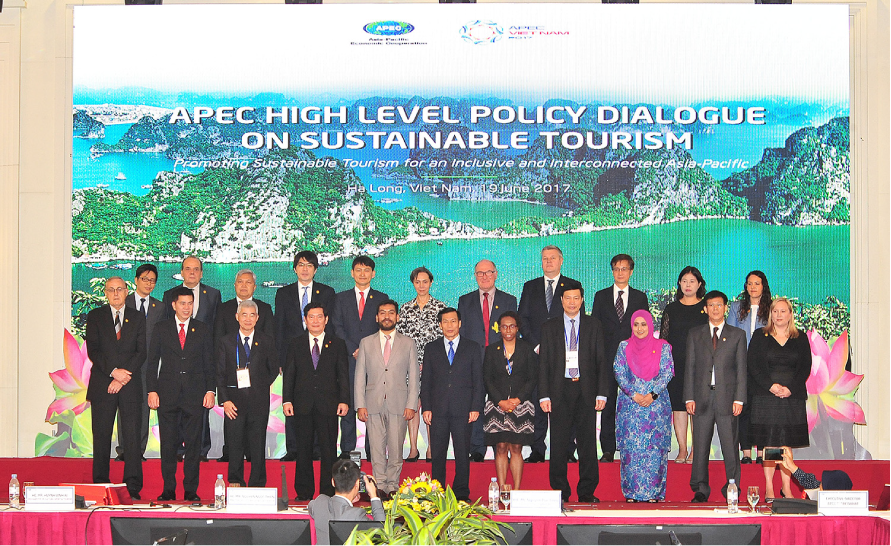
Representatives of APEC economies participated in the High-level Policy Dialogue on Sustainable Tourism held in Hạ Long City on 19 June. (Photo by Nguyễn Khang / VNA)
At these meetings, Viet Nam’s Minister of Culture, Sports and Tourism Nguyen Ngoc Thien once again affirmed that tourism had become one of the pillars of the economy and contributed significantly to the economic development of the APEC members. This is one of the key drivers of sustainable growth, creativity and inclusiveness, contributing to improving people's lives and promoting regional prosperity. It is also projected to be one of the fastest growing industries in the region.
APEC Secretariat Executive Director Dr. Alan Bollard said that the APEC was looking to promote tourism, not only to increase the number of visitors but also to make people’s lives better.
Roger Philip Wigglesworth, Head of the New Zealand delegation, assessed that Policy Dialogue was Viet Nam's innovative idea to promote regional cooperation. This is an important step for tourism cooperation among the APEC economies, as well as between Viet Nam and APEC economies.
Zhou Zheng, Chinese senior tourism expert, said the high-level policy dialogue on sustainable tourism under the framework of 2017 APEC was a meaningful event, because tourism development makes a long-term contribution to mankind.
If sustainable development in all areas, from ecological tourism to cultural and natural tourism, achieves its target and has appropriate management mechanisms, it will ensure sustainable development and can be put into practice in a specific and effective way. This is important for every country because tourism industry now contributes significantly to the growth of national economy and creates employment for each country.
If this issue is overlooked, economic development, cultural heritage inheritance and job search will encounter many obstacles. Therefore, the work that the APEC is doing is good, and the member economies are making efforts together to achieve their goals.
At the dialogue, tourism ministers and heads of delegations in charge of tourism agreed to adopt the 2017 APEC High-level Statement on Sustainable Tourism, entitled 'Promoting Sustainable Tourism for an Inclusive and Interconnected Asia-Pacific'.
The importance of promoting sustainable tourism in the Asia-Pacific region will also be reported by the ministers and the heads of delegations in charge of tourism to the leaders of the APEC economies in November 2017 in Da Nang.
Viet Nam's tourism economy is growing vigorously, aiming to welcome 17 million to 20 million international visitors, contributing to more than 10 per cent of the GDP in 2020.
Viet Nam, for the first time, welcomed 10 million international visitors in 2016 while serving 62 million domestic visitors this year. The total revenue from tourism reached over US$18 billion . Remarkably, visitors from the APEC member countries to Viet Nam reached over 8.1 million, accounting for 81 per cent of the total international visitors to Viet Nam.
With a long-standing, unique and charming culture and history; natural landscapes and beautiful beaches listed among the best in the world; safe and friendly tourism environment; policies of the Party and the State on the development of tourism; and the smokeless industry, Viet Nam continues to be an attractive tourist destination in the world.
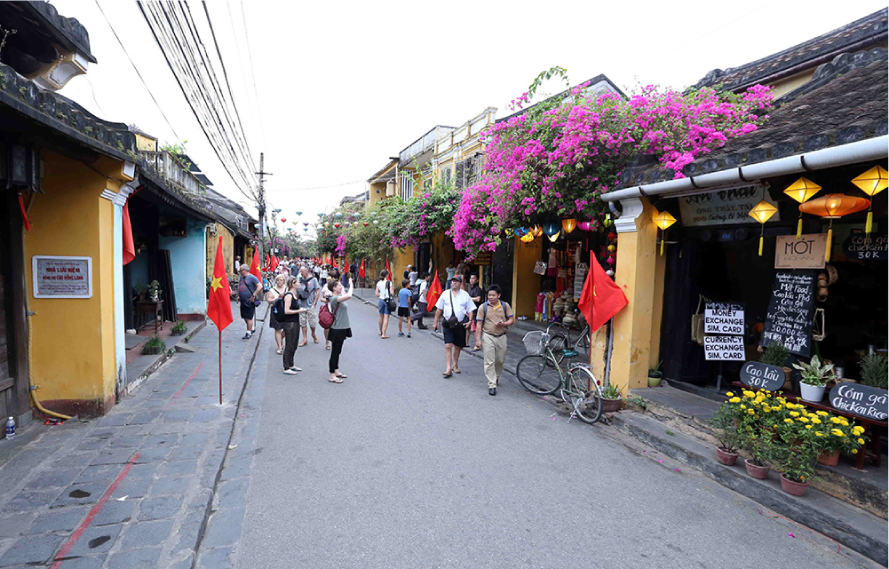
International tourists visit Hội An ancient town. Photo: Quang Quyết / VNA
Macro policy and determination to develop tourism into a spearhead economic sector is demonstrated by Resolution No. 08-NQ/TW issued by the Politburo in early 2017. It clearly defines the target. "By 2020, the tourism industry will become a spearhead economic sector, creating a driving force for socio-economic development; have professionalism, as well as a relatively synchronous and modern system of material and technical facilities; have high quality, diversified and branded tourism products, which demonstrate the nation’s cultural identities and have the capacity to compete with other countries in the region; and will contribute to over 10 per cent of the GDP. The total revenue from tourists is aimed to reach $35 billion, while the export tourism value is targeted at $20 billion. The tourism industry will also create 4 million jobs, including 1.6 million direct jobs."
In June, the National Assembly passed the 2017 Law on Tourism, in which sustainable tourism development has been affirmed as one of the important principles. With many new features compared to the 2005 Tourism Law, there are detailed provisions on sustainable tourism development, protection of the tourism environment, and responsibilities of each subject exploiting, enjoying and being affected by tourism.
In a recent event on the climate change impact on tourism in Viet Nam, Climate Sense, an international expert on climate change, pointed out that many localities in Vietnam are facing the increasingly negative impacts of climate change, especially floods in the central region, beach erosion in Hoi An (Quang Nam), tides in Ho Chi Minh City, and environmental pollution in Hanoi, among others.
Therefore, not only the tourism industry but also tourists and people must prepare and have a plan for unexpected changes in weather and natural disasters. Not only Vietnamese tourism, but also global tourism is considered as a unique field of cultural and economic integration to promote culture, history and nature to contribute to the country’s development.
Therefore, tourism development is not only based on surveying, studying, project planning, constructing facilities to meet demands, and promotion and invitations like many other conventional economic sectors, but also it needs coordination among all actors, especially community participation. Besides these, there needs to be synchronisation of factors, from legal system to master plan with a long vision, comprehensiveness and scientific features. Tourism must protect the life of people and preserve indigenous culture and natural environment, as well as conserve and develop human resources.
In 2016, APEC destinations attracted 415 million international tourists. Tourism and travel directly contributed to $1.3 trillion of the GDP, 6.1 per cent of the regional exports and offered 67 million direct jobs.
Also in 2016, the number of visitors from APEC economies to Viet Nam reached over 8.1 million people, accounting for 81 per cent of the total number of international visitors to Viet Nam.
The APEC 2017 High-Level Sustainable Tourism Declaration adopted in Da Nang in June 2017
has conveyed messages that strongly support principles and actions to promote sustainable
tourism. They are:
- Sustainable development of tourism is a continuous process that requires regular impact
monitoring and evaluation;
- Promoting domestic and regional tourism development policies to support the implementation
of the United Nations Sustainable Development Goals;
- Encouraging long-term, viable economic contributions which bring about benefits to all
stakeholders;
- Respecting socio-cultural identity of the local community; maximising environmental and
natural resources;
- Encouraging consumers’ demands for sustainable tourism activities and products;
- Promoting public-private partnerships as a key measure to develop sustainable tourism
infrastructure and services; creating a competitive environment to support all tourism-related
businesses, especially micro, small and medium enterprises.