Intellectual property plays an increasingly important role in socio-economic life. In the context of economic integration, values of enterprises created by intellectual properties, such as inventions, business confidence and copyrights, are becoming the key to enterprises’ development, helping nations improve their competitiveness and boost economic development.
However, the reality is intellectual property rights’ infringement is taking place in many countries, including APEC member economies. To deal with this problem, each country must strengthen its own instruments. It also requires regional and global cooperation to increase the effectiveness of intellectual property protection system as well as encourage the use, exploitation and commercialisation of intellectual property rights.
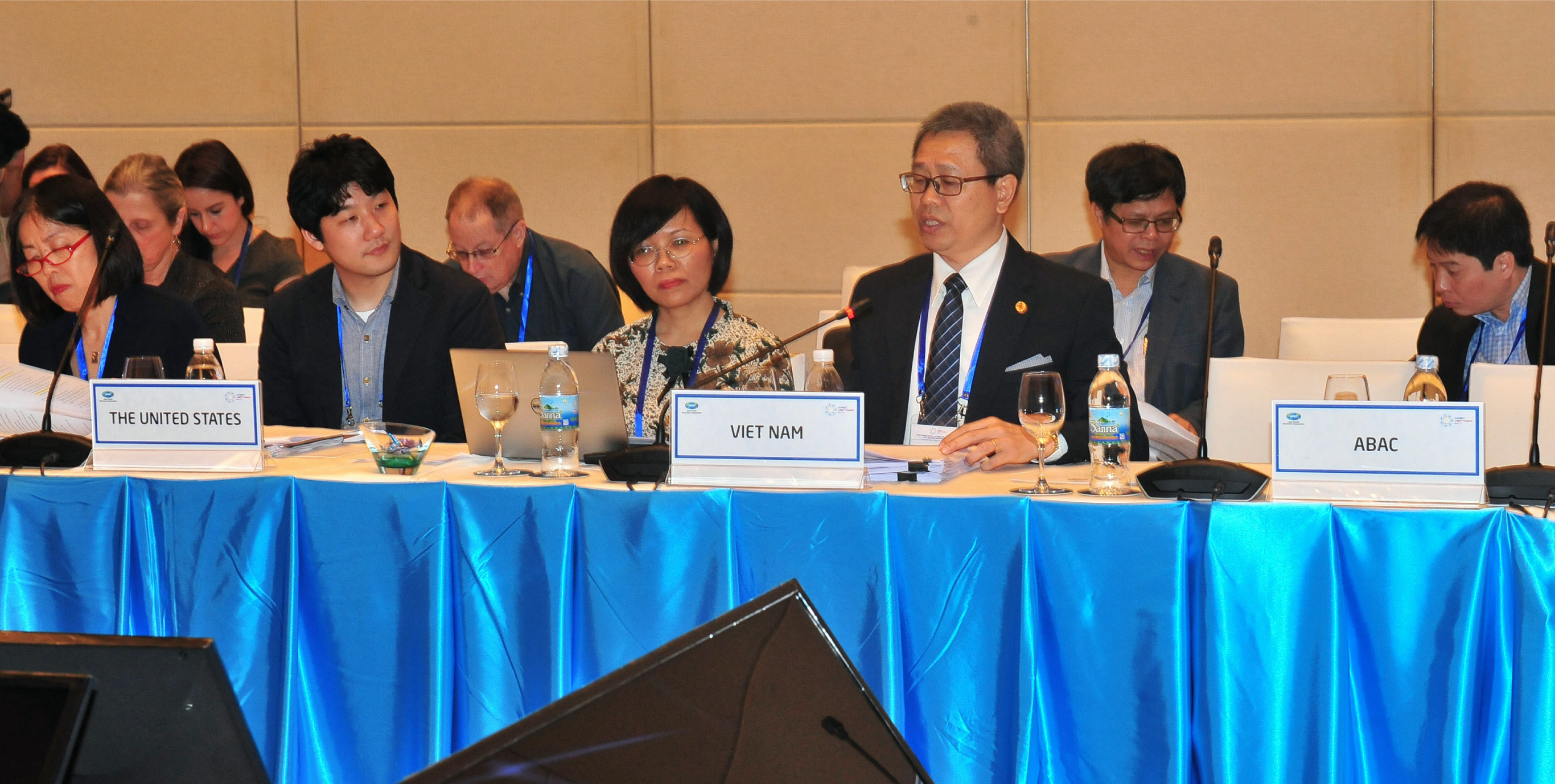
This is an important theme of the 2017 APEC Viet Nam Year. Within this framework, Viet Nam coordinated with the APEC Secretariat Committee to hold the 44th APEC Intellectual Property Experts’ Group meeting (IPEG 44) as part of the Senior Officials’ Meeting (SOM) 1 in Nha Trang in February 2017 and IPEG 45 of SOM 3 in Ho Chi Minh City in August 2017 to share experiences, promote dialogue, find appropriate methods and promote intellectual property rights’ protection in each country.

Copyright infringement and counterfeit and fake product consumption are issues faced by many countries since long. Not only the level and scope of violations, but the schemes are also getting more and more sophisticated thanks to a digital economy, making it a challenge for the force in charge of intellectual property rights’ protection.
For example, recently-launched smartphone versions of Apple and Samsung already have fake versions, resulting in lawsuits worth millions of US dollars. The US Federal’s Court of Appeal reinstated a lawsuit on October 7, 2016, asking Samsung to pay Apple compensation of nearly $120 million for patent infringement, including the patent of “slide-to- unlock” feature and automatic spell correction.
In another example, according to the Federation of the Swiss Watch Industry, China sells 30 million fake Swiss watches per year, higher than the 25 million authentic Swiss watches sold per year. China's fake products industry has grown rapidly, from $250 billion in 2007 to $461 billion in 2013.
In Viet Nam, intellectual property infringement occurs in several fields, including production, processing, circulation and import-export. As an example in the area of software copyright, from 2006 to 2015, the Inspectorate of the Ministry of Culture, Sports and Tourism conducted inspections at 541 enterprises, examined 27,602 computers, fined 499 penalty records of administrative violations with total amount of VND8.613 billion and transferred a document to the investigative agency. Among enterprises violating norms, there were several foreign-invested businesses.
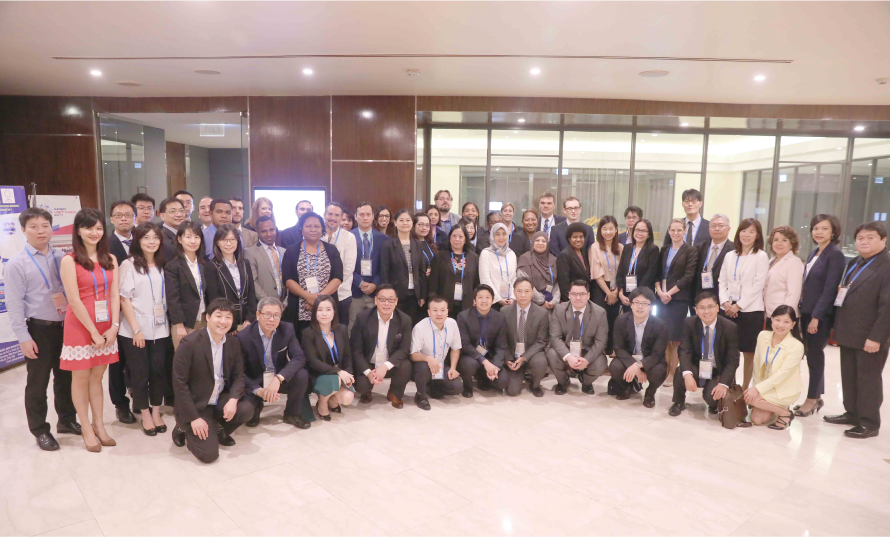
Representatives of APEC economies at a group photo session.VNA Photo Phuong Hoa
Therefore, the APEC intellectual property meeting was significant for many countries. The meeting focused on strengthening dialogue on intellectual property policy and discussing measures to enhance the effectiveness of the intellectual property protection system and implementation of World Trade Organisation’s Agreement on Trade-Related Aspects of Intellectual Property Rights (TRIPS Agreement).
According to Dinh Huu Phi, director general of the Intellectual Property Department (Ministry of Science and Technology), APEC intellectual property cooperation includes policy dialogue on intellectual property such as discussion on issues related to the Doha Negotiation Round, protection of new objects, protection of biological and technological inventions and computer software, geographical indications and traditional knowledge; discussing and implementing measures to support trade and investment such as Initiative Against Counterfeit and Intellectual Property Infringement, establishing an intellectual property service centre of each APEC member economy; discussing and implementing activities to support rapid establishment of rights such as accession to international treaties, harmonisation of trademark applications, cooperation on assessing, searching and disseminating information by electronic means; discussing and implementing measures to promote the use of intellectual property such as intellectual property rights’ management, raising public awareness about intellectual property, the use of patent information; and implementing and developing projects to strengthen and develop the system of intellectual property rights’ protection and enforcement of APEC member economies.
In addition, every year, APEC member economies develop an Individual Action Plan (IAP) to enhance full protection of intellectual property rights under the TRIPS Agreement, accelerate the process of granting protection titles, increase the settlement of intellectual property disputes and strengthen the enforcement of intellectual property rights. According to experts, in the digital economy, the infringements are increasingly sophisticated, causing difficulties for those enforcing intellectual property rights.

The activities of the IPEG Group during 2017 APEC Viet Nam Year follow four common priorities -- promoting sustainable, creative and inclusive growth; boosting broad and deep regional economic integration; enhancing competitiveness and creativity of micro, small and medium enterprises in the digital age; and increasing food security, sustainable agriculture and adaptation to climate change.
With the participation of more than 100 delegates from 21 economies, the IPEG 44 meeting followed common goals of APEC intellectual property cooperation, including increasing dialogue on intellectual property policy and discussing measures to promote the effectiveness of intellectual property protection system, implementing WTO’s TRIPS Agreement; enhancing efforts to effectively implement the Collective Action Plan on Intellectual Property to achieve the APEC Bogor Goals on Liberalisation of Trade and Investment by 2020; human resource development of intellectual property for developing and underdeveloped economies; raising public awareness on intellectual property; and encouraging the use, exploitation and commercialisation of intellectual property rights.
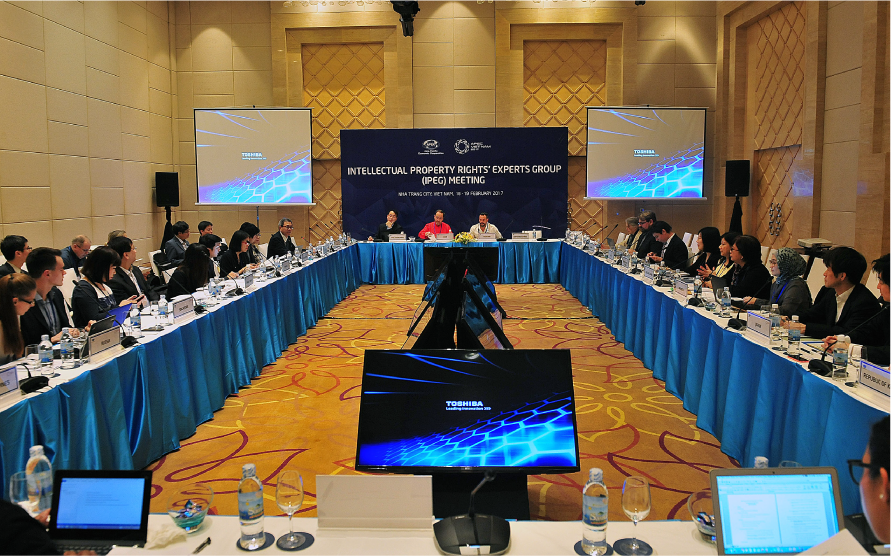
Under the framework of the first APEC Senior Officials Meeting (SOM 1) and related meetings from February 18, 2017 to March 3, 2017, the APEC Intellectual Property Experts’ Group meeting was held on February 18 in Nha Trang City, Khanh Hoa Province. VNA Photo Nguyen Khang
At this forum, the Vietnamese delegation made two presentations – one on the process of applications for international registration of trademark under the Madrid System at the National Office of Intellectual Property and the other on innovative activities of Viet Nam in the field of intellectual property.
On the sidelines of the IPEG 44 meeting, the Vietnamese delegation held bilateral meetings with some member economies such as South Korea and the United States to discuss bilateral cooperation plans on intellectual property in the future.
Meanwhile, IPEG 45 attracted delegates from 19 out of 21 economies. In addition to contributing ideas and experiences on intellectual property rights’ protection, delegates shared and discussed key issues and general purposes of APEC intellectual property cooperation. The Vietnamese delegation gave presentations on electronic registration submission being implemented at the National Office of Intellectual Property since January 2017 and the preparation process to register the Hague Agreement on International Registration of Industrial Designs.
"As a host country, Viet Nam has actively participated in the activities of the IPEG Group, co- chaired a number of initiatives and projects related to plant variety protection and intellectual property at the border and held intellectual property events under APEC 2017 to achieve a series of positive results, thereby contributing to the accomplishment of APEC Bogor Goals on free trade and investment in 2020," Dinh Huu Phi said.

In fact, over the past years, Viet Nam has made significant efforts in promoting the enforcement of intellectual property rights. During his visit to Viet Nam earlier this year, Francis Gurry, former director general of the World Intellectual Property Organisation (WIPO), said on his first visit to Viet Nam in 2010, he was really impressed by the country’s development.
"In Viet Nam, I see policies in the field of intellectual property protection and innovation have been developed. And as the economy increasingly grows, innovation will play a more important role. In the future, I think innovation will exist everywhere, in every activity of the Vietnamese economy," he said.
At a meeting with Francis Gurry, Deputy Prime Minister Vu Duc Dam said the Vietnamese Government has directed ministries, sectors and localities to review and propose amendments to the laws; make major changes in the processes, procedures and mechanisms of appraisal and enforcement of intellectual property rights to create breakthroughs; promote the innovation of the national innovation system such as the world’s model; and place enterprises at the central position.
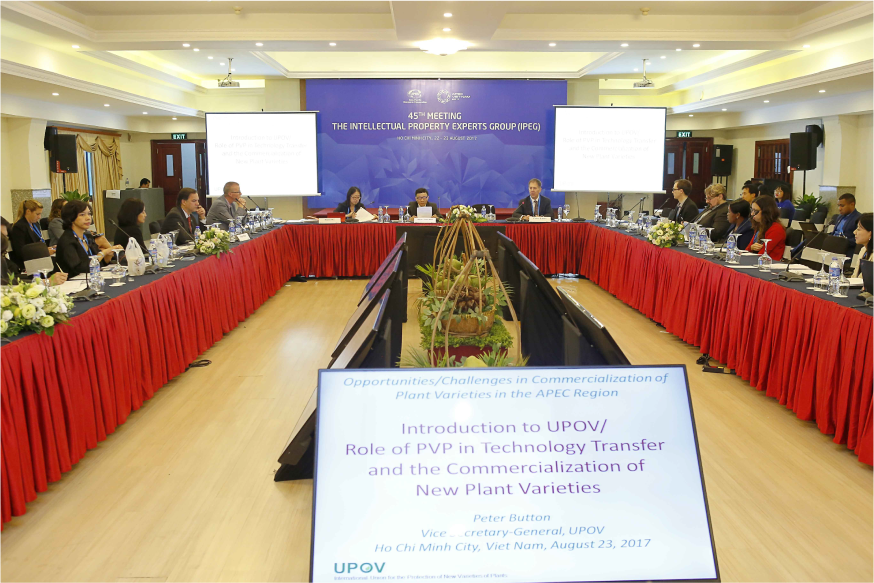
IPEG holds a seminar on "Opportunities and Challenges for Commercialisation of Plant Variety Rights for Developing Economies." VNA Photo Van Diep
State, research institutes and universities are "three vertices of an equilateral triangle," he said. Ministries, sectors and localities must enhance the capacity and effectiveness of protection and enforcement of the intellectual property right system, contributing to the healthy development of business climate and attracting investment in science and technology activities and innovation. This will further improve business climate, enhance competitiveness and strengthen the country's science and technology potential.
Roland Chan, BSA’s senior director of Compliance Programmes, Asia Pacific, said Viet Nam has invested significant resources in protecting and promoting the protection of intellectual property rights. These resources will be effective if enterprises understand their use and implementation well when participating in the international arena.
At another intellectual property event, Tran Van Minh, deputy chief inspector of the Ministry of Culture, Sports and Tourism, said the awareness of Vietnamese businesses on following regulations has improved. According to the BSA Software Association, in 2004, the software infringement rate in Viet Nam was 92 per cent, which decreased to 81 per cent in 2014.
From the perspective of a State Management agency on intellectual property, Dinh Huu Phi, director general of the National Office of Intellectual Property (Ministry of Science and Technology) said along with solutions for policies, mechanisms and building human resources, other issues of great interest are raising public awareness of intellectual property and implementing programmes to support the management; exploitation and enforcement of intellectual property rights, especially for small and medium businesses and creators; and taking a proactive role in expanding international relations so that businesses are able to best protect and exploit their intellectual property rights in Viet Nam and abroad.
-According to the National Office of Intellectual Property, in 2003, the number of patent registrations was 774. The number of registrations for utility solutions was 127 and for industrial designs was 680. The number of registrations for trademark was 12,135. In 2016, this number was 5,228 patent registrations, 478 utility solution applications, 2,868 industrial design applications and 42,848 trademark applications, up 3-8 times compared with 2003.
-According to the Global Innovation Index in 2017, Viet Nam is ranked 47th out of 127 countries and economies, up 12 places compared with 2016. This is the highest ranking Viet Nam has achieved, so far.
In the group of low middle income countries (27 countries), Viet Nam ranks first (up from third place in 2016). In ASEAN, Viet Nam ranks third, behind Singapore and Malaysia but ahead of Thailand.
-On October 2, the General Assembly of the World Intellectual Property Organisation (WIPO) opened its 49th session in Geneva. At the first meeting, representatives from 191 countries agreed to elect Ambassador Duong Chi Dung, head of the Standing Delegation of Viet Nam to the United Nations, WTO and other international organisations in Geneva, WIPO General Council chairman for the 2018-2019 term.