Minister of Trade and Industry Trần Tuấn Anh, stated in May that the facilitation and liberalisation of trade brought practical benefits and contributed to the economies of APEC member countries.
He made this statement on the eve of the 23rd Meeting of Ministers Responsible for Trade, MRT 23, of the Asia-Pacific Economic Cooperation (APEC) Forum in Hà Nội in May.
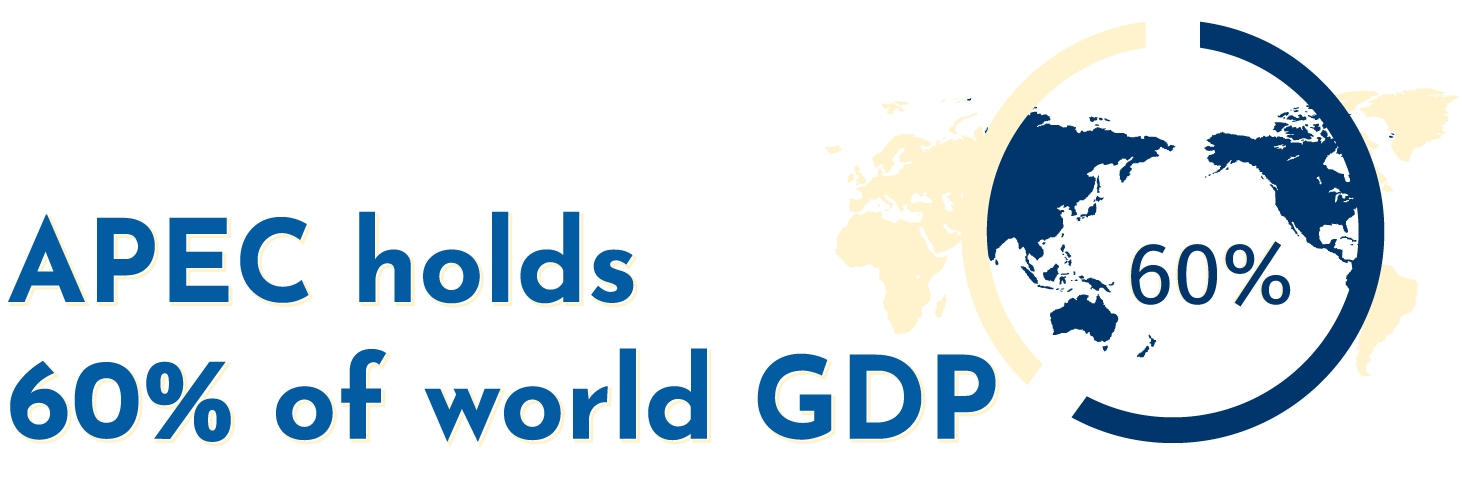
This is highlighted by the rise in APEC's overall Gross Domestic Product, GDP, from US$16 trillion in 1989 to over $20 trillion in 2016, which has increased the level of income of people in the region by 74 per cent, and has helped millions escape poverty. During the subsequent sessions of the MRT 23, delegates of APEC member economies, who account for 60 per cent of the world’s GDP, unanimously agreed on the goal of achieving trade and investment liberalisation by 2020.
The MRT 23 is an opportunity for trade ministers to discuss APEC’s current trade co- operation agreements and its APEC 2020 vision, to promote trade and investment liberalisation.
Under the framework of the meeting, APEC ministers will jointly review the outcomes of co- operation agreements and directives to promote trade liberalisation and implement further reforms.
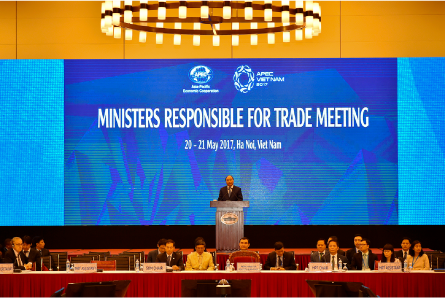
While speaking at the meeting, of Việt Nam’s Prime Minister Nguyễn Xuân Phúc stressed that over the past three decades, APEC economies have grown considerably, accounting for nearly 60 per cent of the world’s GDP.
He emphasised that 49 per cent of international trade transactions saw their average tariffs fall from 11 per cent in 1996 to 5.5 per cent in 2016. The level of income and living standards of people from the region have also increased, he added. “This demonstrates our region's efforts to liberalise and facilitate trade and investment, as well as to share stability, development and prosperity,” he said.
Source: APEC Organizing Committee
Việt Nam joined APEC in 1998, and APEC has played an increasingly important role in Việt Nam's economy. At the present time, Foreign Direct Investment (FDI), from APEC member countries make up 78 per cent of the total FDI in Việt Nam. They also account for 75 per cent of the trade in goods and 79 per cent of international tourists to Việt Nam while around 80 per cent of Vietnamese students are studying in APEC member countries.
Thirteen APEC members are currently Việt Nam’s strategic and overall partners. Trần Tuấn Anh said that according to the forecast released by the International Monetary Fund (IMF) in May, the economic growth of the Asia-Pacific region may reach 5.5 per cent, higher than the previously predicted 5.3 per cent.
"Therefore, I think that in the future, the region will continue to maintain its leading position on the world economic map and will continue contributing to the overall growth of the world economy, due to their production capacity, ability to supply services and enormous consumption power,” he said.
The first APEC Ministerial Meeting in 2017 also highlighted the support of all its members for the need to maintain APEC's role as a driver of regional economic growth and co- operation, as well as to encourage regional co-operation initiatives, for the mutual prosperity of the Asia-Pacific region.
The conference unanimously agreed on the completion of the “Bogor Goals on Trade and Investment Liberalisation” by 2020.

The Bogor Goals was unanimously adopted during the APEC summit in Bogor, Indonesia, in 1994, when APEC was identified as an area for future free and open trade and investment.
According to the Ministry of Foreign Affairs, the Bogor Goals aims to reduce barriers to trade and investment, increase the liberal flow of goods, services and capital, as well as promote and facilitate free trade and investment in the region.
These goals are set to be completed by 2010 for developed member economies, and 2020 for developing member economies.
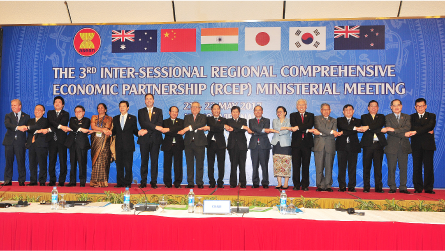
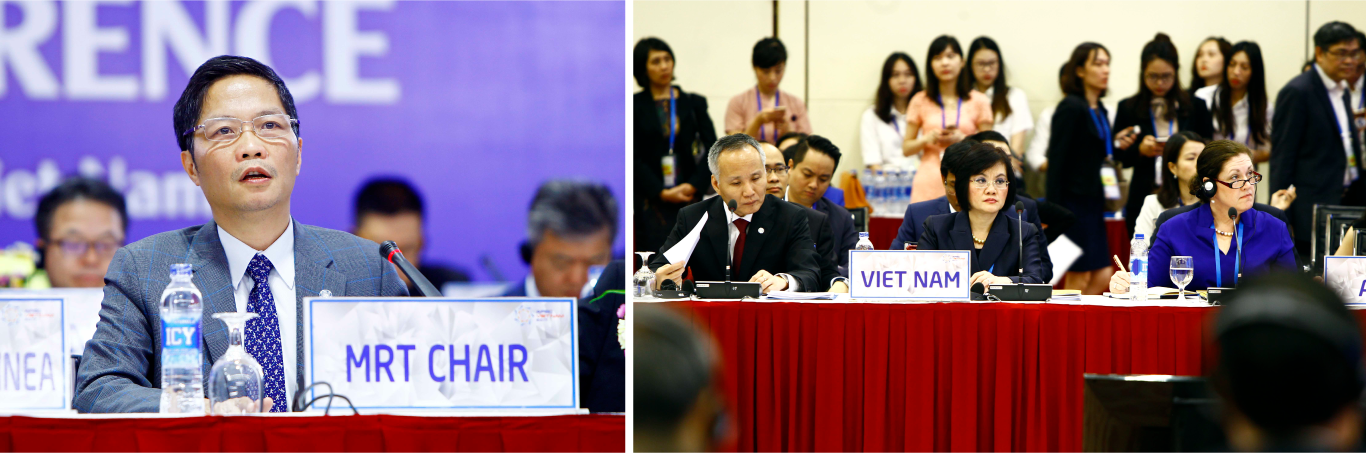
Representatives photographed at the 23rd Asia-Pacific Ministerial Meeting
In 1995, the APEC Summit in Osaka, Japan, adopted the Osaka Action Agenda, OAA, on the implementation of the Bogor Declaration. The OAA set out 10 general principles and specific objectives which are measured in 16 areas, including tariffs, non-tariffs, services, investment, standards and conformity assessments, in addition to customs procedures, intellectual property rights, competition policy, and government procurement. The other areas are policy reviews, WTO obligations, mediation of disputes, business transfers, and income and information analysis, along with transparency, regional trade deals and Free Trade Agreements (FTA).
In 2005, the 13th APEC Summit in South Korea adopted the Busan Roadmap, to complement its co-operation priorities, such as supporting multilateral trade, enhancing the implementation of the collective action plans of each member economy, promoting high- quality FTAs, creating a comprehensive programme for business facilitation, and applying strategic approaches to capacity building.
In November 2006, the 14th APEC Summit in Hà Nội adopted the Hanoi Action Plan, which detailed the implementation of the Busan Roadmap and the the Bogor Goals. However, according to a representative of the Ministry of Foreign Affairs of Việt Nam, due to the profound impact of the global financial crisis in 2008 and 2009 and the declining regional economic and trade growth, the adoption of the Bogor Goals has shown signs of slowing down. Recent APEC summits have therefore emphasised the importance of achieving these goals.

After 11 years, the APEC summit is returning to Việt Nam, and the Bogor Goals are close reaching to its 2020 deadline.
As well as the consensus to continue adopting the Bogor Goals by 2020, the first APEC ministerial meeting in Hà Nội in 2017 demonstrated APEC's determination to continue developing a transparent and sustainable multilateral trade system, with its rules serving as a basis.
Representatives of member economies have also reviewed the progress of several initiatives and priorities for the APEC 2017 summit, such as continuing the implementation of the Lima Declaration on the Asia-Pacific Free Trade Area, establishing cross-border e-commerce facilitation frameworks, and developing an action plan on economic, financial and social development in the APEC region.
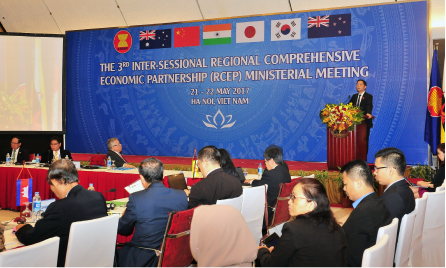
Minister of Trade and Industry Trần Tuấn Anh spoke at the 23rd Asia-Pacific Ministerial Meeting
Active and practical initiatives will be submitted to the 29th Joint Meeting of APEC Economic and Foreign Affairs Ministers and the 25th Summit for approval.
On the sidelines of the 23rd MRT 23 Meeting, a major gathering of ministers and deputy ministers from Australia, Brunei Darussalam, Canada, Chile, Japan, New Zealand, Malaysia, Peru, Singapore and Việt Nam to discuss the Trans-Pacific Partnership (TPP), was also held, where they reaffirmed the economic and strategic importance of the TPP.
The ministers stressed that the principles and standards of this agreement aim to promote economic integration in the region while contributing actively to promoting economic growth among member economies and creating greater opportunities for employees, households, farmers, businesses and consumers.
APEC ministers subsequently agreed to realise the benefits of the TPP agreement while noting the possibility of extending it to other economies, which are able to comply with its stringent standards.
APEC members currently make up 78 per cent of FDI in Việt Nam, 75 per cent of trade in goods, 79 per cent of international tourists to Việt Nam.
About 80 per cent of Vietnamese students are studying in APEC member economies. There are 13 members of APEC who are strategic and overall partners of Việt Nam.
Minister of Industry and Trade Trần Tuấn Anh said that according to the forecast released by the IMF in May, the economic growth of the Asia-Pacific region may reach 5.5 per cent, higher than the previously predicted level of 5.3 per cent.
“Therefore, I think that in the future, the region will continue to maintain its leading position on the world economic map and will continue contributing to the overall growth of the world economy, due to their production capacity, ability to supply services and enormous consumption power,” he said.