Catastrophic natural disasters have not only had a direct impact on lives, but also on sustainable development and poverty reduction efforts of all countries. These disasters have for long disrupted production and business activities for the global economy in general, including member economies of the Asia-Pacific Economic Cooperation (APEC).
As such, increasing community participation, narrowing the "adaptive gaps" in disaster prevention, is a top priority for APEC. This can then develop into combined co-initiatives and agreement on the framework for action, moving from passive response to active prevention and progress towards comprehensive and systematic disaster risk management.
According to the Emergency Disaster Response Group (EPWG - APEC), the Asia-Pacific region is vulnerable to several types of disasters, both natural and manmade. On average, in every decade, this region is impacted by some 40 per cent of the world's natural disasters.
It is also the area to have suffered the most natural disasters in history, such as the Indian Ocean tsunami in 2004, the historic floods in Thailand in 2011 and Typhoon Koppu, which landed in the Philippines in 2015 and caused heavy loss of lives and damage to property. Most recently, two hurricanes -- Harvey and Irma -- repeatedly ravaged the United States with severe consequences for the surrounding islands and states of Texas and Florida.
In an annual report released by the World Meteorological Organisation (WMO), it was estimated that 2016 was the hottest year in the Earth's history with abnormal changes in the polar ice sheet, increasing sea levels and warming oceans. The temperature in 2016 was 1.1 degrees higher than the pre-industrial level and 0.06 degrees higher than the previous record in 2015.
In 2017, extreme weather events have continued to be unpredictable, including sudden changes in the Arctic. WMO also warns that drastic changes in the global climate system seem to be worsening. This could push worldwide climate systems into an "uncontrollable" state.

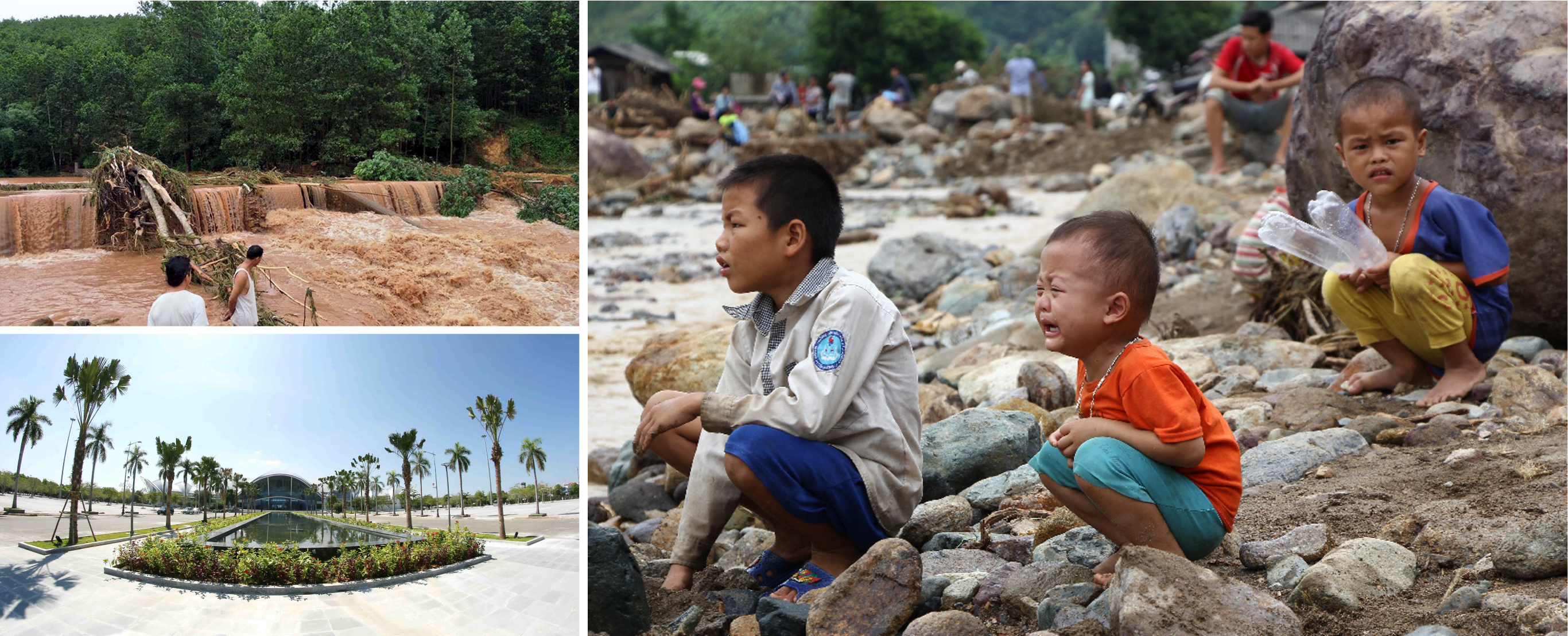
Deluge in October 2017 in Hòa Bình Province, which left 41 dead, missing or injured by floods and landslides. (Source: VNA)
David Carlson, director of the World Climate Programme, stressed that even without El Niño, 2017 is still witnessing other unusual weather variations across the planet, beyond human understanding of the global climate system.
Realistically, over the years, climate change has led to numerous consequences -- from melting icecaps, rising sea levels, rainstorms, floods and whirlwinds to large-scale disasters such as earthquakes, tsunamis and droughts. All these have contributed to food shortage and disease outbreaks in both humans and livestock.
So where does climate change originate? Why has climate change now become more unpredictable, even going so far as to become "uncontrollable?"
According to meteorological experts, humans are 90 per cent responsible for climate change becoming increasingly unpredictable. In particular, the process of coal, oil and gas burning accounts for 60 per cent of CO2 emissions, and up to 70 to 90 per cent if one counts other fuels. This is the main factor causing global warming and resulting in unpredictable and extreme weather conditions.
Deputy Minister of Agriculture and Rural Development Hoàng Văn Thắng affirmed that the more developed an economy’s activities are, the greater the associated risk of natural disasters become. Therefore, disaster prevention is one of the top priority tasks within APEC. Over the years, APEC member economies have strengthened cooperation in disaster prevention, response and disaster mitigation.
Through conferences, seminars, roundtables and high-level dialogues, APEC member economies have exchanged views on practical interests, experiences and policies to effectively implement disaster risk management in the context of climate change.

By the end of the 2017 APEC Year, Việt Nam will have hosted more than 200 meetings in different parts of the country, including eight ministerial-level meetings, high-level dialogues and four high ranking officials meetings. The 25th APEC Summit will be held from November 5 to 11 in Đà Nẵng City.
A Policy Dialogue between APEC Agriculture Ministers and CEOs on "Responsible Use of Resources for Sustainable Food Production and Agricultural Business," held on August 24 in Cần Thơ City, is one of the first events of APEC Việt Nam 2017.
At present, Việt Nam had asked delegates to focus on issues related to the relationship between food security and climate change, sustainable natural resource management and improved food production and nutrition in the Asia-Pacific region to adapt to climate change.
Minister of Natural Resources and Environment Trần Hồng Hà said nearly 20 years after the APEC Business Advisory Council called on APEC leaders to set up the APEC Food System at the end of 1998, its three basic missions (addressing the development of rural infrastructure, disseminating technical advances in food production and processing, and promoting food trade) remain true to date.
However, we are currently living in a world where resources such as land, water, sea and forests are becoming increasingly rare due to the impact of population growth and urbanisation. Globally, there is a rapid increase in the frequency and intensity of extreme weather events.
Therefore, for effective disaster preparation and control, it is imperative for APEC to have a comprehensive solution, in addition to relying on traditional experiences, to further develop essential infrastructure, and, in particular, strengthen the development of support tools and application of technical advances in forecasting, warning and integrated disaster management.
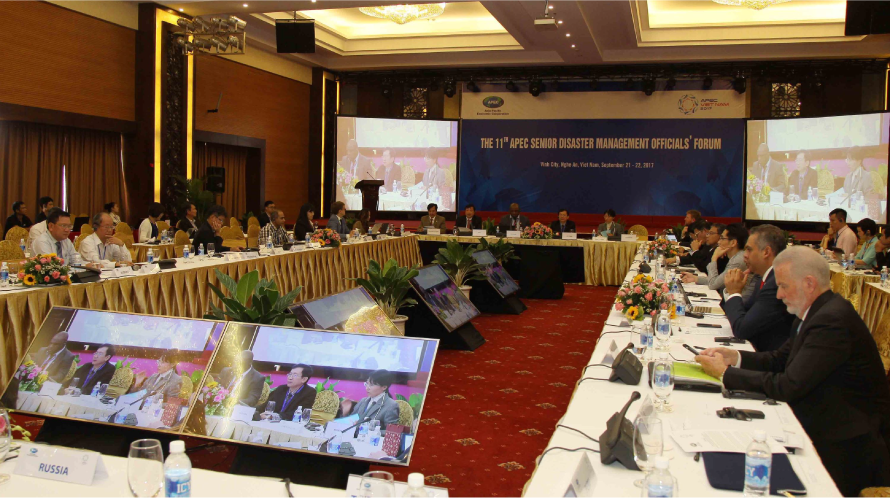
Technical Meeting No. 2 during APEC Senior Officials Meeting on Disaster Management, held in September 2017. (Source: VNA)
Disaster prevention activities within APEC should also be incorporated into the socio-economic development plans of different levels, sectors and localities. One of the key issues is cooperation in the field of science and technology to enhance common understanding of the “new normal" natural disasters and the risks around us.
According to scientists, investing in minimising the risk of natural disasters is very costly, but can be highly effective. With annual US$6 billion investment in disaster mitigation, the world can avoid losses of $360 billion over the next 15 years.
Previously, the APEC Workshop on Community-Based Disaster Risk Management, held on September 18 and 19, 2015, in Quân Ninh, was considered an important APEC activity organised by Việt Nam. We are deeply committed to international integration and preparation for hosting of the 25th APEC Summit and other APEC related activities in 2017.
The mentioned workshop is also one of the 80 initiatives proposed by APEC in Việt Nam, contributing to enhancing the practicality of APEC cooperation and bringing cooperation results to life.
Under the theme "Community-Based Disaster Risk Management in the Context of Climate Change," the workshop attracted 100 participants from APEC member economies, the Bureau of Mitigation under the United Nations Development Programme, the International Federation of Red Cross and Red Crescent Societies, etc.
Deputy Minister of Foreign Affairs Vũ Hồng Nam stressed on the unpredictable dangers of natural disasters, which have prompted APEC member economies to intensify policy coordination, promote cooperation and take decisive action to implemenent more effective community response and disaster preparedness.
Experts, managers, and scientists have all highlighted global initiatives, including the UN initiative on the 2015-2030 Sendai Framework for Action on Disaster Risk Reduction. In fact, APEC has implemented several activities and initiatives to integrate disaster prevention and mitigation with the realisation of the sustainable development goals.
The workshop organised by Việt Nam was the first initiative within APEC in terms of community-based natural resource management. The initiative also confirms Việt Nam’s role and contribution to APEC as well as the country’s responsible contribution to the international community's efforts to reduce disaster risk in the context of climate change.

Standing Member of the Central Steering Committee on Disaster Prevention Trần Quang Hoài emphasised that natural disasters and increasing climatic events are a global concern in the 21st century. In addition, with the help of the international community, Việt Nam has made efforts to prevent and mitigate natural disasters, moving from adaptation to active prevention and progressing to risk management.
With the "National Strategy for Natural Disaster Prevention, Response and Mitigation to 2020," Việt Nam has implemented a number of comprehensive and coordinated solutions from the central to local levels, integrating natural disaster prevention and mitigation into climate change, and incorporating a socio-economic development plan with disaster prevention and mitigation projects to adapt to climate change.
Hoài stressed that APEC 2017 is an opportunity for Việt Nam and APEC member economies to exchange views on interests, share experiences and policies to effectively implement the management of community-based disaster risk in the context of climate change and apply advanced science and technology for early forecasting.
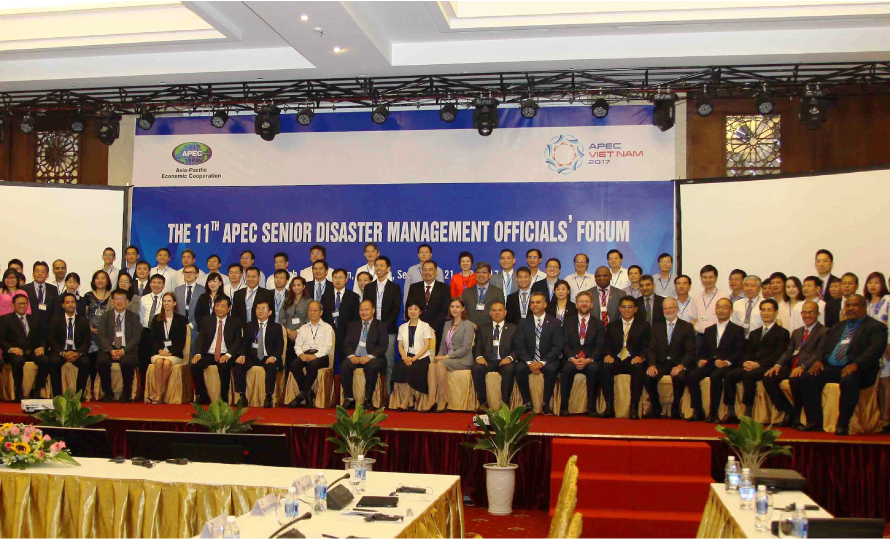
APEC Senior Officials Meeting on Disaster Management, held in Nghệ An Province in September 2017. (Source: VNA)
Agreeing with Hoài, General Deputy Minister of Agriculture and Rural Development Hoàng Văn Thắng said Việt Nam, as a member of APEC and also one of the economies often affected by various types of disasters, has long considered narrowing the gap between adaptation and sustainable development a key objective.
In the context of increasingly destructive natural disasters, the only way to ensure sustainable development is clean production, following the green growth model, and affirm compliance with the commitments signed by Việt Nam under the Paris Agreement to reduce emissions of greenhouse gas. The country is committed to reducing greenhouse gas emissions by eight per cent by 2030 and could even reduce it by 25 per cent provided sufficient effective support from the international community.
Therefore, application of high technology in business production and reducing greenhouse gas emissions, especially in the field of agriculture, are Việt Nam’s top priority. This would mean the existence and development of an agricultural production chain linking farmers, entrepreneurs, scientists, managers and banks.
According to Minister of Natural Resources and Environment Trần Hồng Hà, under to the APEC Year 2017 agenda, Việt Nam has set out four priorities for cooperation -- sustainable, creative and inclusive growth; regional economic integration; competitiveness and creativity for micro, small and medium enterprises; and food security and sustainable agriculture responding to climate change.
Since Việt Nam has entered into the Paris Agreement, it is necessary to consider the application of information and high technology to be able to build a strategy for developing agricultural products in the aforementioned production chain, ensuring harmony with international standards and responding to climate change in the direction of reducing greenhouse gas emissions towards effective disaster risk management.
According to a report published by the United Nations Office on Disaster Reduction (UNICEF) on October 13, an average of 14 million people worldwide have been displaced by disasters such as floods and storms. Asia has suffered the most.
Specifically, eight out of the 10 most threatened countries are located in the South Asia and Southeast Asia region, including India (with an average of 2.3 million people displaced each year) and China (an average of 1.3 million people per year).
In Việt Nam, according to statistics from the Ministry of Agriculture and Rural Development, in the last 20 years, nearly 11,000 people have died or are missing, with average annual GDP loss of VNĐ20 trillion (an equivalent of 1-1.5 per cent of total GDP). In particular, damage caused by flash floods and landslides occupy an average of some 15 per cent.
In particular, in the first eight months of 2017, this figure increased to 35 per cent, just counting flash floods and landslides in the four provinces of Sơn La, Yên Bái, Điện Biên, and Lai Châu in early August, in which 42 people died, 239 houses were washed away and total damage was worth VNĐ1.4 trillion.