The world is already well within the fourth industrial revolution, with digitalisation permeating ever deeper into every step of production, and opening more opportunities for integration of technology in every sector.
Accordingly, super powerful applications will emerge in increasing number, thanks to ‘quantum leaps’ made in the fields of Artificial Intelligence, Big Data, and Internet of Things (IoT).
In this context, the pressure of competition from ‘giant’ corporations will just become more fierce, while small- and medium-sized enterprises (SMEs) remain vulnerable, due to their limited financial resources and capacity, management capabilities, and technological levels.
Against this backdrop, the Asian-Pacific Economic Forum (APEC) 2017 has chosen the theme ‘Creating new dynamism, Fostering a shared future,’ aiming its agenda towards the business community, especially the micro-, small- and medium-sized enterprises (MSMEs), creating a ground-swell of opportunities for them to share best practices, boost business and investment, connect with leaders and officials, as well as other businesses in the region, which will hopefully result in more partnerships and co-operation agreements, and taking advantage of market, finance, and technology potentials. APEC is also a great time for SMEs to showcase their images, their products and services to potential partners within APEC, as well as throughout the world.

Within the framework of APEC 2017, Vietnam held the 24 th Small and Medium Enterprises Ministerial Meeting (SMEMM 24) in the southern economic centre, HCM City, on September 15, with the theme “Enhancing MSMEs’ Competitiveness and Innovation in the Digital Age.”
At the meeting, Prime Minister Nguyen Xuan Phuc said that in the context of the Industry 4.0, the impact of digitalisation can be felt by every business and every people, noting that Vietnam’s National Assembly has passed the Law on Supporting Small- and Medium-Sized Enterprises. Phúc said that in the spirit of building a facilitating and action-oriented administration, the Vietnamese government has implemented numerous policies to create a healthy, fair, equal, and trustworthy business environment.
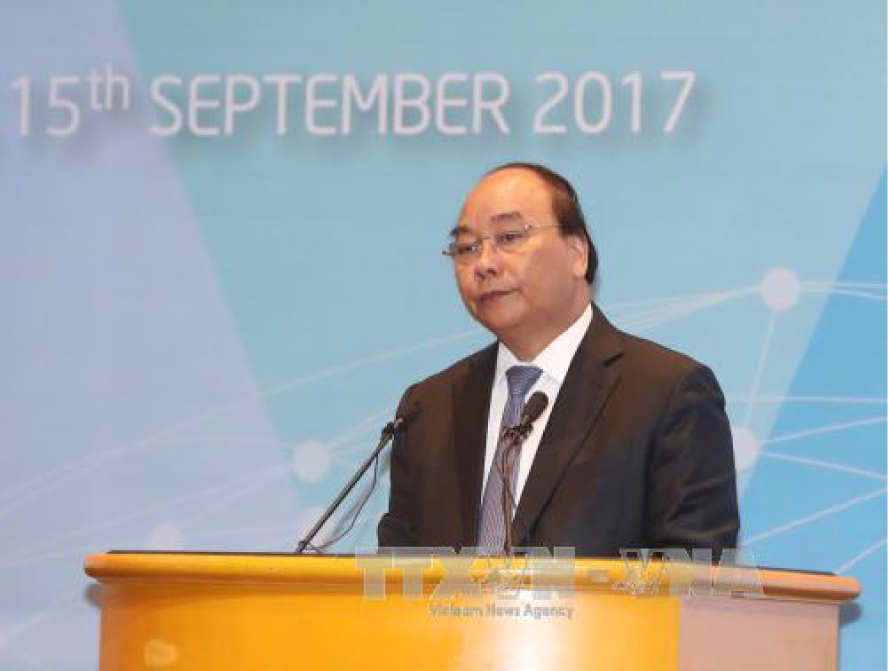
Prime Minister Nguyễn Xuân Phúc spoke at the Small and Medium Enterprises Ministerial Meeting (SMEMM 24) on September 15, in HCM City (Photo: Thống Nhất – VNA).
From Vietnam’s reality, PM Phuc called for co-operation of APEC member economies to increase the tax system capacity, in order to foster production and business, as well as prevent transfer pricing and other tax evasion schemes by some foreign investors.
In addition, the Vietnamese PM also asked senior officials to establish a support fund, which will help encourage SMEs to enhance co-operation with multinational corporations and companies, and enable robust participation in the global value chain.
In his address, Phuc said that in order to strengthen SME’s competitiveness and innovation, APEC need to work on a set of comprehensive measures, which aim to achieve the following goals:
“First, to create favourable conditions for businesses to access markets and engage deeper into the global value chains.
Second, to facilitate the business environment of micro, small and medium-sized enterprises (MSMEs) by improving their access to advanced technology and managerial skills, as well as by supporting capacity building through education, consultancy and business connection. “Third, to promote APEC’s entrepreneurship in the digital age, to encourage start-ups and business ethics compliance.
Fourth, to develop a sustainable and friendly start-up environment to boost the spirit of innovation among SMEs in the region, with an emphasis on the empowerment of women in business.”
According to Nguyen Chi Dzung, Vietnam’s Minister of Planning and Investment, the world is moving towards a digital economy, with the role of knowledge and technology moving into the driver’s seat.
Old growth models based on natural resource exploitation has become outdated – due to its inefficiency, unreliability, and unsustainability. Now is the time for new models of growth, driven by the engines of innovation, improved productivity and product quality, he said.
“With massive developments in technology and science, the incessant changes in the world’s economy, presenting both new challenges and opportunities for SMEs, the State agencies must be able to catch up with latest trends and manage to create a facilitating environment and deploy appropriate legal support measures to boost innovation, and thus, the development, of SMEs,” Dzung said.

Fully aware of new economic trends and the sweeping changes to production made possible by digital technologies, the Prime Minister has signed off on Directive 16/CT-TTg regarding enhancement of a capacity building approach towards Industry 4.0.
The government has identified the characteristic of Industry 4.0 is to ride on the pervasive nature of digitalisation and information technology. However, the ‘technological waves’ take place in different countries at different rates of speeds and intensity.
In order to proactively ‘capitalise’ on the new opportunities and minimise the negative impacts brought about by Industry 4.0 to Vietnam, the government is determined to focus on creating a breakthrough leap in information technology infrastructure, application and human resources –developing digital infrastructure and ensuring cybersecurity, all with the aim of allowing people and enterprises to receive better and easier access to digital content development.
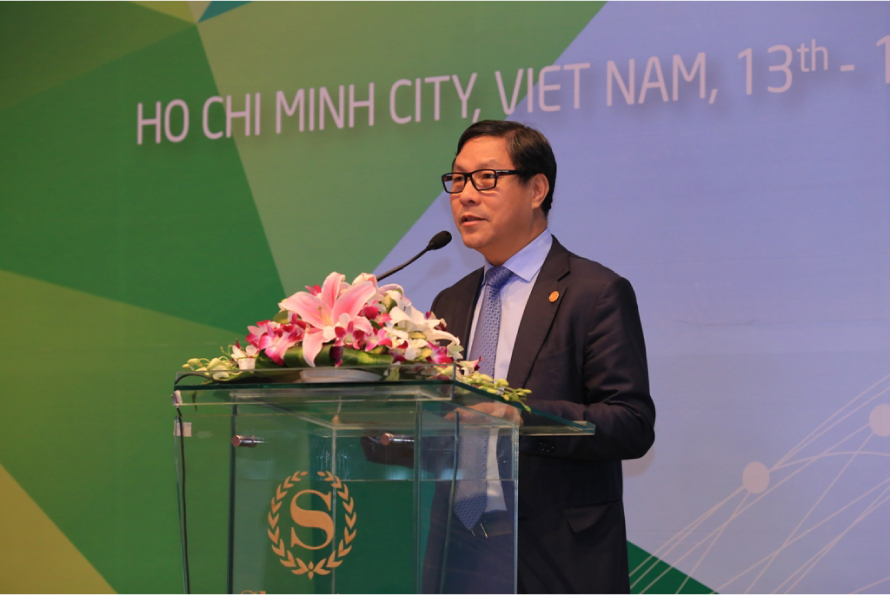
Deputy Minister of Planning and Investment, Dang Huy Dong spoke at the Small and Medium Enterprise Working Group Meeting. (Photo: APEC)
In addition, resolutions No.19-2017/NQ- CP, No. 35/NQ-CP, and No. 36a/NQ-CP reaffirmed the government’s determination to improve the competitive business environment, promote the development of enterprises, and, in particular, enable small and medium enterprises to acquire and develop new production technology systems.
According to the planned roadmap, the Ministry of Information and Communication will focus on the development of an information infrastructure, with an emphasis on the completion of a 4G network by 2018, in tandem with studying for the future launch of 5G to power the Internet of Things, as soon as possible.
However, the country’s economic experts remain cautious and have pointed out numerous challenges in the creation of a digital era or building smart cities in Việt Nam, as well as limitations in awareness of the administration agencies, business community and the public at large.
Most private enterprises are slow in adopting new technologies; therefore, productivity and quality goods still leave much room for improvements. Moreover, in general, the development of private enterprises remains unsustainable and fragmented, due partly to their limited financial capacity and lack of access to capital. Furthermore, management capacity and the skills of labourers in private SMEs remain poor, which will also limit their ability to become more deeply integrated into the global economy.

The formation of APEC has enabled new opportunities for enterprises to better access a potential market of 2.8 billion people, with the increasingly improved business environment.
Specifically, APEC’s Bogor goals regarding trade and investment liberalisation, in addition to numerous short-, medium-, and long-term action plans, have brought down intra-regional taxes from 17 per cent in 1989 to 5.6 per cent in 2014, which helped to raise total trade turnover to US$18.4 trillion in 2014, a considerable four-fold jump in the 1996-2014 period.
With the aim of strengthening SMEs, APEC member economies always strive towards creating the best conditions for SMEs to better integrate into the regional and global value chain.
Through the implementation of Supply-Chain Connectivity Framework (2009) and Connectivity Framework (2013), and APEC Strategic Blueprint for Promoting Global Value Chains Development and Cooperation (2014), the forum aims to increase efficiency of the supply chains by at least 10 per cent.
Accordingly, many programmes and policies have been implemented, bringing practical benefits to enterprises.
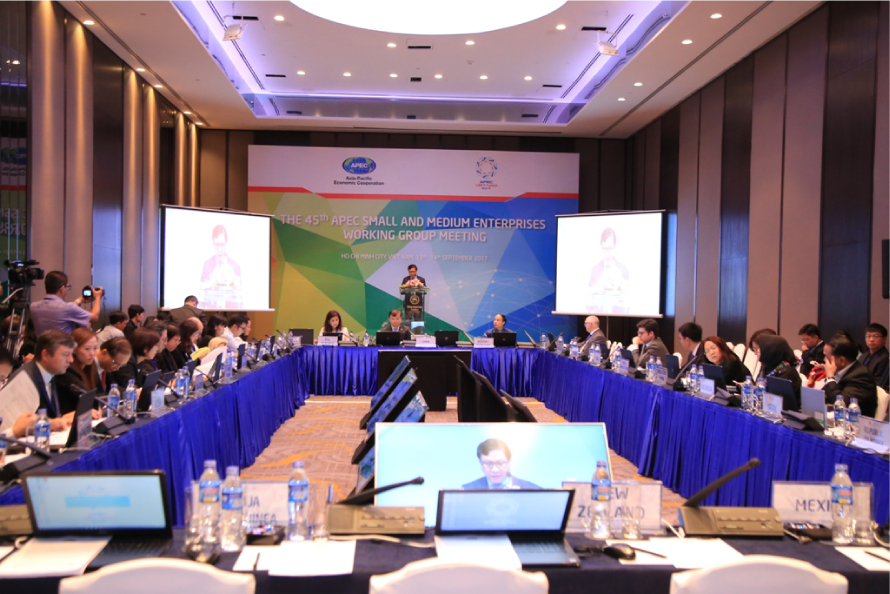
The 45th Small and Medium Enterprises Working Group (Photo: APEC)
Through the participatory mechanisms of enterprises in APEC, high-level meetings, such as the APEC CEO Summit and the APEC Business Advisory Council (ABAC), have made available two-way dialogue channels between enterprises and leaders of the member economies.
From this, enterprises can have an opportunity to have their feedback be taken into account in the formulation of policies and measures to promote trade, investment, and growth in the region.
APEC Business Travel Card (ABTC), a travel document issued to business travellers who are citizens of APEC member economies, implemented since 1997 by 19 members (the US and Canada are still reviewing the programme), has facilitated the travel, work, and co-operation between businesspeople in the region. By the end of 2016, 200,000 businesspeople – including 40,000 Vietnamese – have received the travel cards.
In addition, APEC's "one-stop-shop" mechanism (2007) helped to considerably improve the business environment of the whole block by 14.6% in every field in the 2010-2015 period – from businesses, access to credit to business licenses, and trade transaction costs (which fell by 5% in 2007-2010 period), which in total helped to save $58.7 billion.
In addition, the number of company establishment procedures has dropped by more than 20% (2009-2013) and the duration of construction permit processing has decreased from 169 days to 134 days (2011 - 2015).

The 2017 APEC SME Ministerial Statement focused on a number of topics: Green, sustainable and innovative micro-, small- and medium-sized enterprises; Enhancing MSMEs’ access to markets, modernisation and competitiveness; Promoting start-ups; and Strengthening MSMEs’ entrepreneurship and business ethics.
Accordingly, green and sustainable development received much attention, with the public-private partnership approach poised as a measure to create an enabling environment where MSMEs can participate in green activities in a cost-effective manner and to enhance green awareness and necessary skills of MSMEs.
Delegates at the ministerial meeting had also pointed out challenges in the green development of the region, mostly due to the limited understanding of the benefits of a green economy, a lack of skills to develop green technology, and other limitations in credit access.
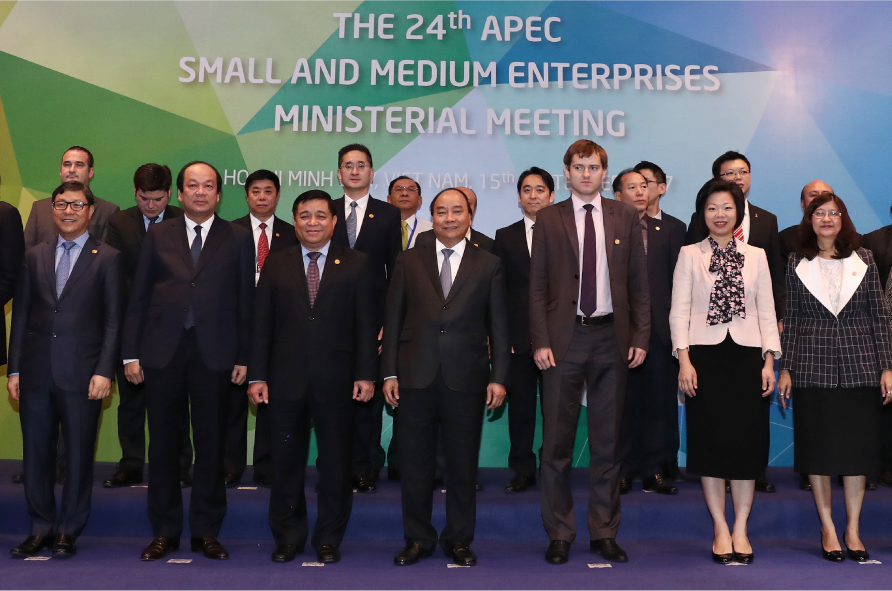
Prime Minister Nguyen Xuan Phuc and the Heads of delegations attending the Small and Medium Enterprises Ministerial Meeting (Photo: Thong Nhat-VNA)
To promote the competitiveness of SMEs, the APEC SME Center for IT Promotion will become the link between SMEs and other related agencies from APEC member economies. The APEC SME Center for IT Promotion is “expected to serve as a platform to share policies, experiences and IT best practices, and to provide consultations on IT solutions,” which will contribute to the improvements of APEC SMEs’ IT application levels.
The ministers had reiterated their commitment to fortify ethical business practices to “free SMEs from the high costs of corruption” and “support their ability to access global markets.”
The conference also called for APEC economies to implement similar frameworks and continue towards full adoption of APEC Principles for codes of ethics, as instructed by APEC Ministers and Leaders. In addition, the ministers asked for APEC Guidance for Ethical Third Party Intermediary Relationships in the Medical Device Sector and encouraged its implementation. This guidance serves as a concrete tool to support thousands of SMEs that play a critical role in the medical device sector, such as distributors, wholesalers and sales agents.